
How It Works
The science of a glorious poop.
Nothing beats the feeling of a truly great poop. But what makes it so satisfying? It isn't luck — it's biology, and your gut is the unsung hero.
Your digestive system is not just a food chute. It's a high-functioning network of nerves and bacteria in constant conversation with your brain. When the gut is in sync, mood improves, stress eases, and everything downstream works better. Here's what's actually happening when everything goes right.
The mechanics
What happens when everything goes right
1
Your gut talks to your brain
A dedicated nervous system lines your digestive tract, and most of your body's serotonin is made there. The conversation runs around the clock — which is why gut trouble so often shows up as mood trouble.
2
What makes a poop "glorious"
Smooth, formed, easy to pass, fully done. Not too hard, not too soft — Type 3 or 4 on the Bristol Stool Scale. Your colon said its piece and moved on.
3
Why most people fall short
The average American gets roughly half the daily fiber they need. Add dehydration, an out-of-balance microbiome, and chronic stress, and the genuinely satisfying version becomes the exception instead of the rule.
4
The ecosystem does the work
Trillions of gut bacteria break down what you can't, feed the cells of your colon, and set the pace. Diversity and consistency are what they ask for in return.
— It's not luck.

Your poop is a mirror of your gut health.
That's the whole story, really. Shape, ease, and rhythm are your gut's daily report card — and when things are flowing, everything feels easier. The inputs are unglamorous: fiber, water, movement, a microbiome that's looked after. The output speaks for itself.
The system
Built the way your gut works.
The Happy Gut Trio — a gentle reset, an everyday fiber foundation, and long-game biotic support. Three things that work together.
Shop the Happy Gut Trio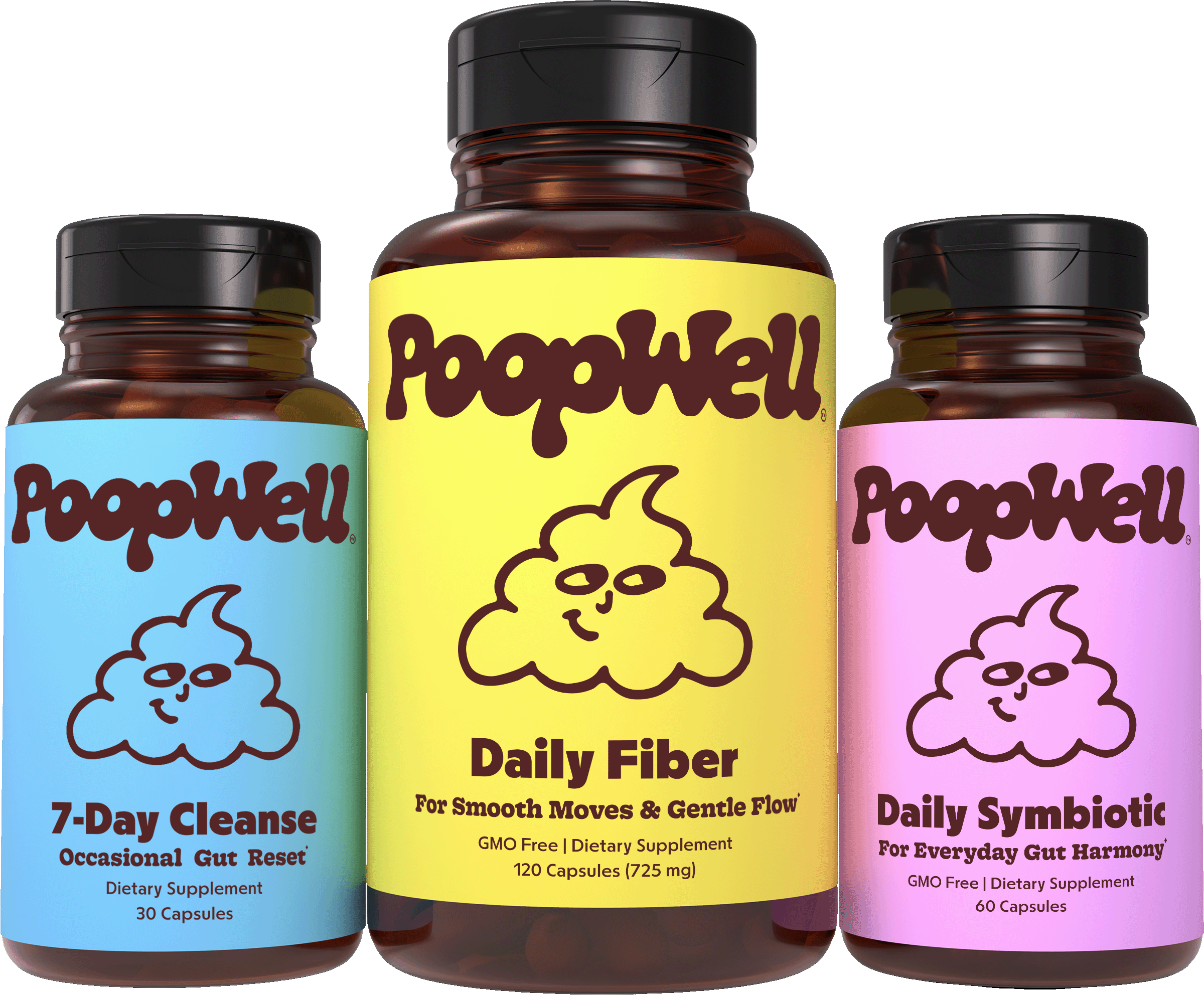
Sources
- Lewis SJ, Heaton KW. "Stool form scale as a useful guide to intestinal transit time." Scandinavian Journal of Gastroenterology, 1997;32(9):920–924.
- Gershon MD, Tack J. "The serotonin signaling system: from basic understanding to drug development for functional GI disorders." Gastroenterology, 2007;132(1):397–414.
- U.S. Dietary Guidelines for Americans, 2020–2025 — fiber identified as a nutrient of public health concern; dietaryguidelines.gov.