Life Moments

Postpartum digestion: what nobody warns you about.

8-minute readFor the fourth trimester

There are a thousand books about pregnancy and roughly none about what happens to your digestive system after. So here it is, plainly: after you deliver a baby, your gut needs time — and a little help — to find its way back.

The first poop after delivery can feel like a bigger event than it has any right to be. Things may be slow, swollen, sore, and strange for a while. All of it is common, most of it is temporary, and none of it should be a mystery.

What's going on

Why everything slowed down

Your body spent nine months making room for someone else. The digestive system gave up the most real estate — and it's the last department anyone checks on.

1
Hormones are still driving
Progesterone slows digestion during pregnancy, and it doesn't snap back the moment the baby arrives. For a little while, slow is the default setting.
2
The usual suspects: pain meds and iron
Pain relief after delivery — especially after a C-section — is famously constipating. So are iron supplements. Worth knowing before you wonder what you did wrong. (You didn't.)
3
Those muscles just ran a marathon
Your abdominal wall and pelvic floor did something enormous, and they're stretched, tired, or healing. The mechanics of pooping are temporarily different — not broken.
4
The fear is real (and normal)
With stitches, tears, or hemorrhoids in the picture, your brain may try to veto the whole operation. The dread of the first one is nearly universal — and holding back only compounds it, because the longer stool waits, the more water it loses and the harder it gets. It's almost always gentler than you fear.
5
Routine is on leave
You're sleeping in fragments, eating with one hand, and drinking water when you remember. Routine is your gut's favorite thing, and routine is currently busy.

— One miracle at a time.

Barry
The playbook

What actually helps

1
Water, more than usual.
Especially if you're breastfeeding — milk production draws fluid your colon was counting on. Keep a bottle wherever you feed.
2
Fiber, gently.
Fruit, oats, vegetables — and a fiber supplement if your provider gives the nod. The goal is soft and regular, not heroic.
3
Don't fight the stool softener.
If your provider offers one, take it. This is not the week for toughing it out.
4
Feet up, lean forward.
A small footstool under your feet changes the angle and spares the pelvic floor. If there are stitches, gentle counter-pressure with a clean pad can take the fear out of it.
5
Go when it calls.
Holding it makes everything harder. Literally. The baby can wait ninety seconds; the urge may not.
6
Be patient with the timeline.
The first one usually arrives within three to five days. Feeling like yourself again is measured in weeks, not days — and that's normal too.
The serious bit

Call your provider if

You'll be asked about your baby constantly and about yourself almost never. These are the things worth bringing up at any checkup — or sooner:

  • No bowel movement four to five days after delivery.
  • Severe abdominal pain, or pain at an incision or tear that's getting worse instead of better.
  • Blood in your stool, or rectal bleeding beyond light hemorrhoid spotting.
  • Trouble controlling gas or stool — common, treatable, and exactly what pelvic floor physical therapy is for. Ask.
  • Hemorrhoids that won't settle down with time and home care.

The Gut Guide is education, not medical advice. Your provider knows your delivery — ask them first about stool softeners, supplements, all of it. (Barry, despite the confidence, is not a doctor.)
When you're ready
Rebuild the routine.
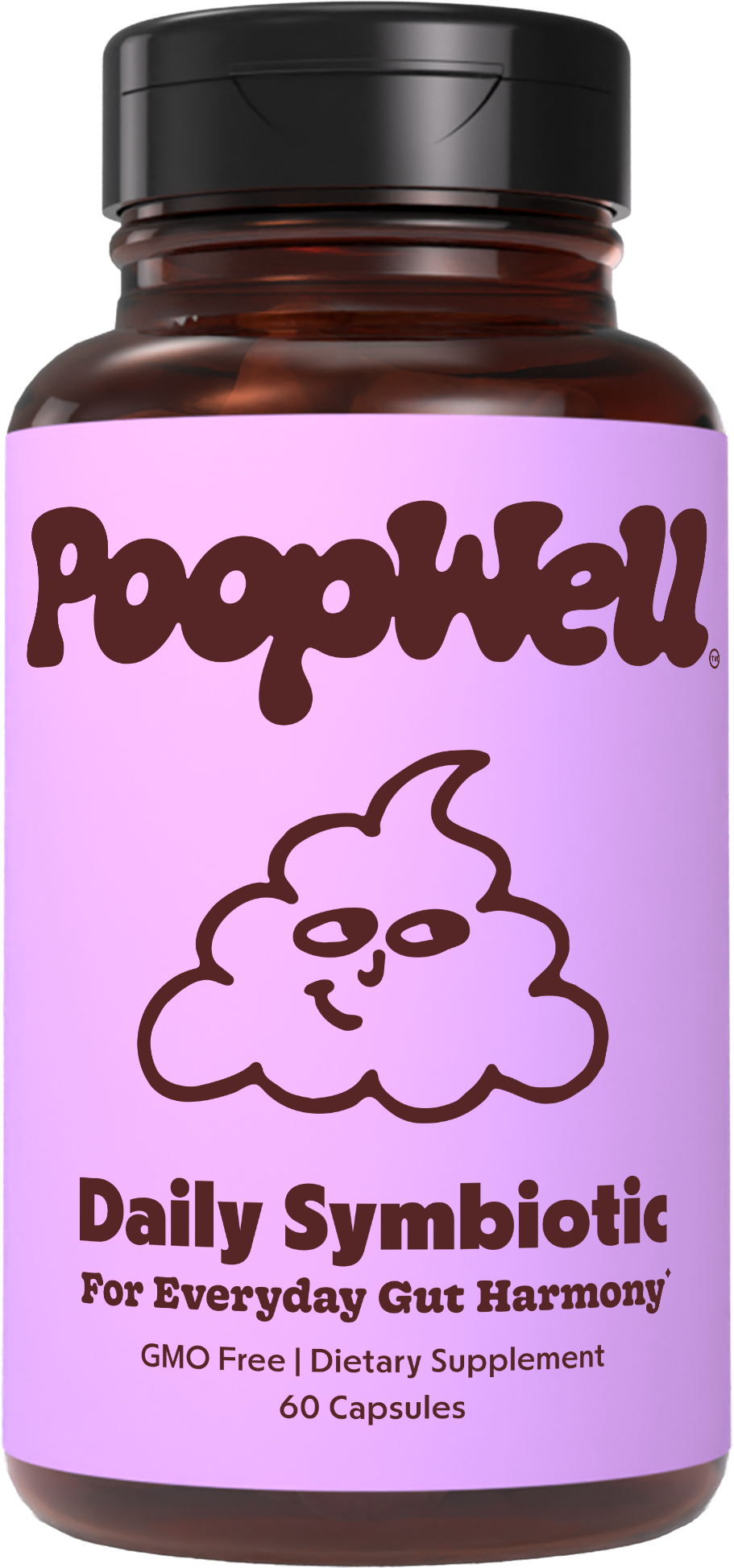
Daily Fiber and Daily Symbiotic are there when your provider gives the all-clear — gentle, daily, no heroics required.
Shop the lineup
PoopWell product
Back to the Gut Guide

Sources
  • American College of Obstetricians and Gynecologists (ACOG). Postpartum care and recovery guidance — acog.org.
  • National Institute of Diabetes and Digestive and Kidney Diseases (NIDDK). Constipation: symptoms, causes, and treatment — niddk.nih.gov.
  • U.S. National Library of Medicine. Opioid-induced constipation and postpartum analgesia, StatPearls — ncbi.nlm.nih.gov.